
What Does It Cost to Start a Mobile Auto Detailing Business?
There are three real entry points into this business, and the one you choose should be based on your cash position and your risk tolerance, not on what looks coolest in a YouTube setup video. The $850 Sedan Trunk Kit is a Ryobi 1,800 PSI electric pressure washer, a 6-gallon portable freshwater jug, a Ridgid 4-gallon wet-vac, a five-pack of microfiber towels, and a starter chemical bundle from Chemical Guys or Detail King. It is enough to do exterior washes and basic interior vacuums. It is not enough to do full resets or ceramic work. Use it to get your first ten clients and your first testimonials, then reinvest. The $5,200 Used Cargo Van Skid is where the real business starts: a used Transit or Express van with 80,000 to 120,000 miles, a 65-gallon poly tank, a Mytee or Sandia extractor, a 2,000-watt inverter or a 100Ah lithium battery bank, and a full chemical kit. Buy the van used. Buy the extractor new. The extractor is a precision tool that fails in ways that ruin jobs if it is worn out.
The $18,500 Turnkey Rig is a newer van, a Kranzle or Mi-T-M hot-water pressure washer, a dual-battery lithium system, a full ceramic coating kit, and a wrapped exterior. This is the setup you build toward in year two with profits, not the setup you finance on a credit card in week one. On the chemical side, buy concentrates in 5-gallon jugs from Superior Products or Urable — the per-ounce cost versus quart bottles will shock you once you run the numbers.
Now for the ambushes. Commercial auto liability insurance runs $1,200 to $2,400 annually (est.) and most carriers want the first month or a down payment upfront before you touch a single car. Budget it. Your first 5-gallon chemical order will run $300 to $500 before you dilute a single bottle. Budget that too. And keep a $1,000 cash cushion in a separate account for the moment your water pump dies on a Tuesday morning with three jobs on the books. It will happen. The operators who survive it are the ones who saw it coming.
| Equipment / Category | Lean Trunk Kit ($850) | Typical Solo Van Skid ($5,200) | Premium 2-Tech Fleet Rig ($18,500) |
|---|---|---|---|
| Pressure Washer & Gun | Ryobi 1,800 PSI 1.2-GPM electric + MTM SGS28 stubby gun + 50-ft Uberflex hose ($165) | Active 2.0 electric (2.0 GPM) or Kranzle K1322TS + Coxreels 100-ft stainless reel ($680) | Honda GX390 4.0-GPM belt-drive skid + dual 100-ft high-pressure reels ($1,850) |
| Vacuum & Air Agitation | Ridgid WD4070 4-gal 5.0-PHP vac + auto pro hose kit ($119) | Ridgid 12-gal + California Air Tools 8010 compressor + Tornador Black Z-020RS ($460) | Dual-motor commercial vac + 20-gal compressor + dual Tornador guns ($1,150) |
| Carpet & Seat Extractor + Steam | Bissell SpotClean Pro 3624 + drill brush set ($165) | Mytee S-300H Tempo heated extractor + McCulloch MC1385 steamer ($890) | Mytee Lite 8070 heated 210°F extractor + Chief Steamer 100 PSI ($2,250) |
| Water Tank, Pump & DI Filtration | Customer spigot + 50-ft Flexzilla hose ($38) | 100-gal baffled poly tank + Seaflo 12V pump + CR Spotless DIC-20 DI resin tank ($820) | 150-gal custom aluminum baffled tank + RO/DI system ($1,750) |
| Power Source / Generator | 12-gauge 50-ft lighted extension cord to client outlet ($55) | Predator 3500W Super Quiet Inverter Generator ($799 at Harbor Freight) | Honda EU7000iS fuel-injected quiet inverter generator ($4,999) |
| Polisher, Pads & Lighting | Griot's Garage G9 9mm DA polisher + 6 Lake Country pads ($185, optional Wk 2) | Rupes LHR15 Mark III + Griot's G8 mini + Scangrip inspection light ($690) | Dual Rupes LHR15 + Flex PXE 80 + full ceramic infrared curing lamp ($1,650) |
| Chemicals & Microfiber Towels | P&S Xpress, Koch-Chemie Pol Star, Superior Dark Fury, ONR, 36 Rag Company towels ($123) | Full 5-gallon concentrate rack + IK Foam Pro 12 + 100 GSM-graded towels ($340) | Bulk drum concentrates + 200-towel rotation + Gtechniq/CSL ceramic inventory ($850) |
| Entity, Insurance Deposit & Vehicle | Use existing sedan/SUV; bind $115/mo insurance after booking Seed Car #1 | Mount skid in existing pickup/minivan + LLC ($150) + Ins. deposit ($230) + Urable ($91) | Used Ford Transit 250 / Chevy Express ($4,000 down payment + vinyl lettering) |
| TOTAL OUT-OF-POCKET STARTUP COST | $850 (Lean Cash Start) | $5,200 (Self-Contained Skid) | $18,500 (Turnkey 2-Tech Fleet Rig) |
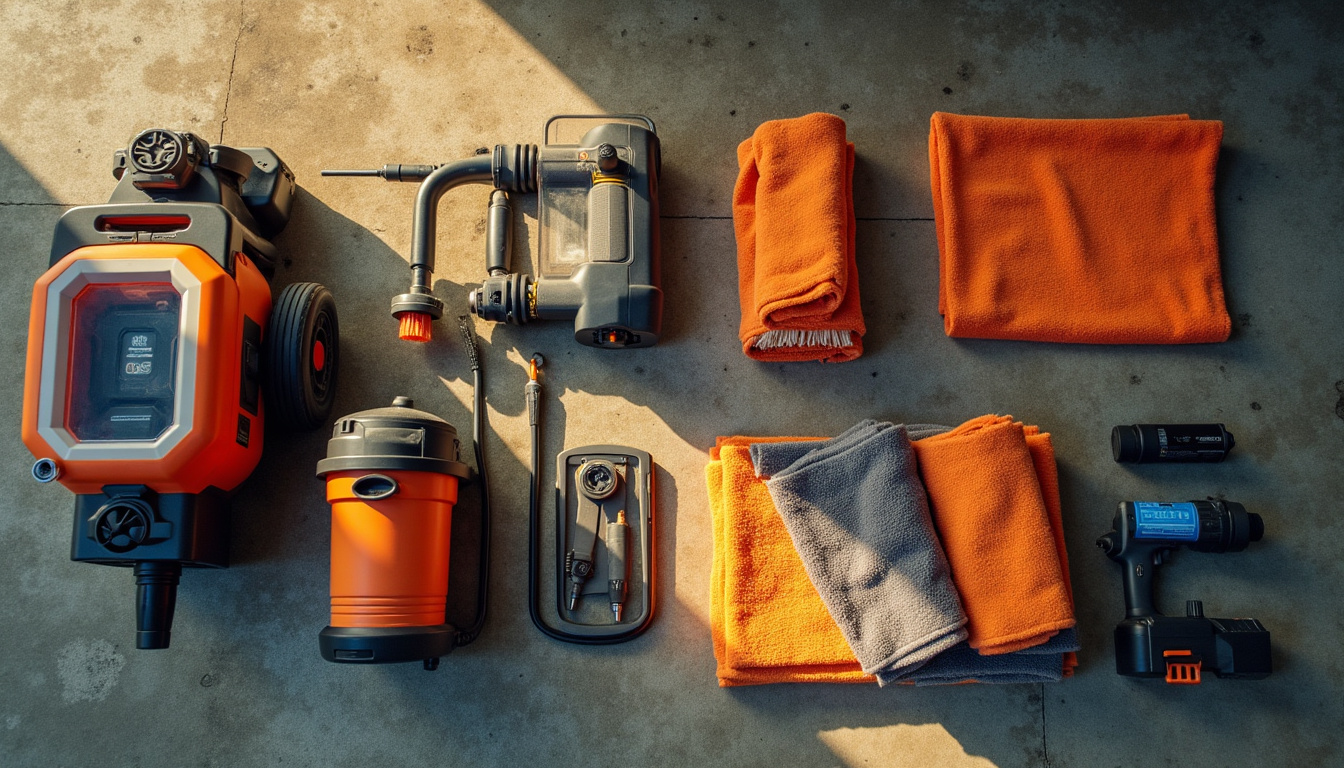
The $850 Sedan Trunk Kit: Check What You Already Own in Your Garage
Most homeowners already own several items on the Day-1 gear list. Check any tools you already have below to see your real out-of-pocket cash needed this weekend.
What Is the Cash Curve and Breakeven Timeline for Mobile Detailing?
Mobile detailing is one of the few service businesses where you can reach breakeven before the end of your first week. On a lean $850 trunk kit, your hard costs per job — chemicals, fuel, water — run roughly $18 to $25 per job (est.). That means job number four or five covers your entire startup investment. On a $5,200 van skid setup, breakeven comes in roughly 18 working days (est.) at two $285 jobs per day. There are almost no negative cash months in residential driveway detailing if you price correctly from day one, which is a genuinely rare thing in any business and the main reason this model keeps showing up in lean-startup conversations.
But here is where operators get buried when they try to scale fast: commercial fleet accounts pay on Net-30 or Net-45 terms. That means you wash twenty vehicles this week, invoice the fleet manager, and wait six weeks to see the money. Meanwhile, you are buying chemicals, paying for fuel, and possibly paying a second tech every Friday. If you sign two or three fleet accounts at once without a working-capital cushion, you will be cash-flow negative even while your revenue looks great on paper. It has killed real businesses run by smart people. The fix is simple but requires discipline: build your recurring residential club revenue to cover your fixed costs first, then add fleet accounts as upside, not as your foundation. Residential clients pay at the driveway. That is the cash-flow model that keeps this business solvent while you grow.