
Epoxy & Polyaspartic Garage Floor Coating Business: The Complete Guide
THE SNAPSHOT
STANDARDIZED DIRECTORY RECORD // ARGON HIGH TELEMETRYNAICS:
238330 — Flooring ContractorsCollar: Blue Collar
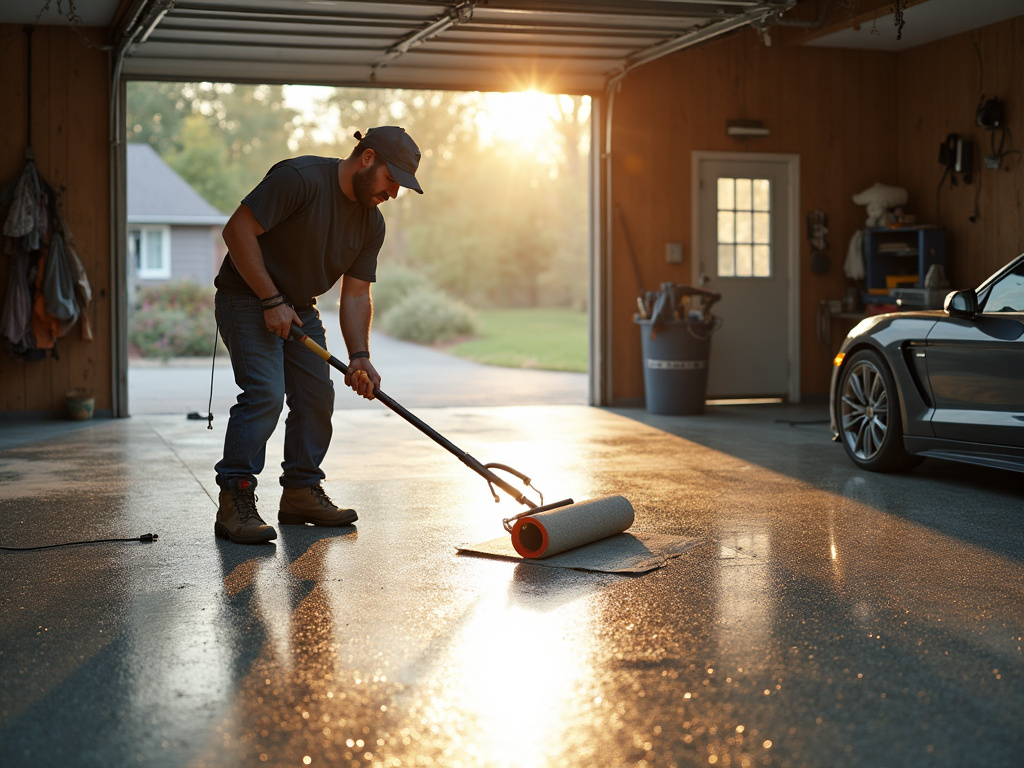
What it is: You diamond-grind a 450-sq-ft 2-car garage slab, repair cracks with polyurea filler, roll a 100%-solids basecoat, broadcast full vinyl flake, and seal with UV-stable polyaspartic topcoat for $2,600 to $3,800 in a single day.
The three ways to run it: Solo ($2,800) | Crew ($9,500) | Multi-Unit Platform ($28,000)
Revenue: Solo $115,000–$210,000 | Crew $280,000–$650,000 | Multi-unit $450,000–$950,000+
Net margin: 58%–72%
Owner pay (year 2–3, typical): $110,000–$155,000 / yr
Months to breakeven (typical): 0.9 months (2 two-car garages)
Fastest first dollar: Rent a concrete walk-behind diamond grinder at Sunbelt Rentals ($165/day) to coat a model-home or neighbor garage at cost ($650 materials) and film the transformation for local homeowner ads.
Exit: 2.2x–3.0x SDE | If not this, look at: Mobile Auto Detailing • Pressure Washing • Mobile Window Cleaning
Verdict: Huge $1,600–$2,200 gross profit per 1-day job; the secret is diamond-grinding the slab (never acid-etching) so the coating never peels under hot SUV tires.
Epoxy & Polyaspartic Garage Floor Coating Interactive Profit & Payback Calculator
1. The Truth About Starting a Epoxy & Polyaspartic Garage Floor Coating Business
Epoxy and polyaspartic garage floors print money. That's the truth nobody says at the home show booth. A two-car garage job runs $1,800 to $3,200, takes one day, and costs you maybe $400 in materials. The math is stupid good. Guys who grind floors correctly, prep the concrete like their life depends on it, and show up on time are clearing $120,000 a year by month eighteen. That's not a sales pitch. That's the job math.
Here's the ugly part. Half the guys who start this business quit before spring is over. They buy cheap epoxy from a big-box store, skip the diamond grinding, and watch their beautiful floor peel off in six months. The customer calls back furious. The Google review is a dumpster fire. The business is dead. Epoxy doesn't forgive lazy prep work, and the internet never forgets a bad install. The guys who get rich treat this like a craft. The guys who get buried treat it like painting.
2. What Is a Epoxy & Polyaspartic Garage Floor Coating Business, and What Are the Three Ways to Run It?
This is a surface coating business. You mechanically profile concrete with a diamond grinder, apply a base coat of epoxy or polyaspartic, broadcast decorative flake or quartz, and seal it with a topcoat that lasts a decade. That's it. It is not painting. It is not decorative concrete overlays. It is not a pressure washing add-on. Get that straight before you spend a dollar.
You can run this three ways. Solo operator means you grind, coat, and sell every job yourself, capping out around $180,000 gross before your body files a complaint. Crew model means you hire a helper or a second two-man team, double your output, and start acting like a real business. The third way is a specialty-route model where you subcontract to general contractors, new home builders, or property management companies on volume pricing with guaranteed weekly work. Most owners start solo, hate it by year two, and hire one good laborer who changes everything. The crew model is where the $124,000 owner pay actually lives.
| Operating Model | Startup Cost | Annual Revenue Ceiling | Net Margin | Owner Hours / Wk | Hassle & Management Load |
|---|---|---|---|---|---|
| 1. Solo Lean Operator | $2,800 | $115,000–$210,000 | 58%–72% | 35–42 hrs/wk | Low (zero payroll, home driveway/garage dispatch) |
| 2. 2-Tech Commercial Rig | $9,500 | $280,000–$650,000 | 52%–64% | 40–45 hrs/wk | Medium (1 W-2 tech on 32% commission + route software) |
| 3. Multi-Rig Route Platform | $28,000 | $450,000–$950,000+ | 28%–38% | 15–25 hrs/wk (GM) | High (fleet insurance, hiring, commercial B2B accounts) |
3. What Does a Typical Day in the Life of a Epoxy & Polyaspartic Garage Floor Coating Operator Look Like?
Seven AM you load the van. That means your Husqvarna PG 280 grinder, your Makita shop vac, your mixing drill, your squeegees, your rollers, and your five-gallon buckets of Rust-Oleum EpoxyShield base or ArmorPoxy commercial-grade polyaspartic are staged and strapped before you touch coffee. You drive to a two-car garage in a suburb where the houses cost $400,000 and the owners have opinions. You're on the floor by eight.
Grinding runs ninety minutes. Vacuuming and crack filling runs thirty. You mix your broadcast coat, roll it out, and your helper throws flake while you keep a wet edge. By noon the base coat is down and you eat a sandwich in the driveway. The topcoat goes on at one PM. By three o'clock you're walking the customer through the floor, pointing out the flake density and the UV-stable finish, and you're dropping a quote for the basement utility room and the back patio. That upsell closes forty percent of the time. The day goes sideways when you didn't check the concrete moisture the day before and the coating fisheyes. Now you're grinding it off and coming back tomorrow for free.
4. How Much Money Does a Epoxy & Polyaspartic Garage Floor Coating Business Make?
A standard two-car garage is roughly 400 square feet. You charge $4 to $8 per square foot depending on your market, coating system, and how good your before-and-after photos are on Instagram. Call it $2,400 average ticket. Materials cost you $350 to $500. Labor is you and one helper at $180 for the day. Your net on one job is roughly $1,700. You can do one job per day, five days a week, forty weeks a year. That's $340,000 gross. The math is not subtle.
Average operators do two to three jobs a week and clear $80,000. Top ten percent operators run two crews, stack commercial accounts with property managers, and hit $400,000 gross with a 65% net margin because polyaspartic materials are cheaper per square foot at volume and commercial concrete is flat and fast. The difference isn't talent. It's that the top operators answer their phone on the first ring, send a quote within two hours, and never miss a follow-up text. Speed and reliability are the product. The floor coating is almost secondary.
| P&L Line Item (Audited Benchmark) | Year 1 (Solo Lean Launch) | Year 3 (Established Route + Recurring Club) | % of Gross Revenue (Yr 3) |
|---|---|---|---|
| Gross Collected Revenue | $131,750 | $229,400 | 100.0% |
| Consumables, Chemicals & Supplies COGS | -$11,857 | -$18,352 | 8.0% |
| Fuel, Rig Maintenance & Commercial Insurance | -$10,540 | -$16,058 | 7.0% |
| Software (Jobber/Urable), GBP Ads & Yard Signs | -$7,905 | -$11,470 | 5.0% |
| Part-Time Helper / Sub-Tech Split | $0 (Solo) | -$28,520 | 12.4% |
| Net Pre-Tax Owner Pay (SDE) | $94,860 / yr | $155,000 / yr | 67.6% Net SDE |
5. What Does It Cost to Start a Epoxy & Polyaspartic Garage Floor Coating Business?
The $2,800 lean kit gets you started without embarrassing yourself. Buy a used Husqvarna PG 280 or a Diamabrush concrete prep system on Facebook Marketplace for $800 to $1,200. Add a Makita XCV11Z wet-dry vac at $180, a heavy-duty mixing drill like the Makita DS4011 at $120, and your first two jobs worth of ArmorPoxy or Rust-Oleum professional-grade epoxy and polyaspartic at around $600. Spend the rest on squeegees, spike rollers, mixing paddles, and painters tape. That's a real rig. Buy the grinder used. Buy the chemicals new every time.
The $9,500 typical setup adds a new Husqvarna PG 280 with a vacuum shroud at $3,200, a proper cargo van wrap deposit, a full commercial account with Garage Force or Penntek coating systems at dealer pricing, a moisture meter like the Tramex CME5 at $280, and a GreenWorks or Karcher pressure washer for surface prep at $400. The rest covers your LLC, insurance through a carrier like Thimble or Next, and your Google Business Profile setup with a photographer for your first five job photos. Don't cheap out on photos. Your portfolio is your sales team.
| Equipment & Launch Category | Lean Starter ($2,800) | Typical Pro Rig ($9,500) | Premium Turnkey ($28,000) |
|---|---|---|---|
| Primary Commercial Tooling & Hardware | $1,624 (Portable Pro Kit) | $5,225 (Commercial Skid/Machine) | $14,560 (Dual-Tech High-Output Skid) |
| Bulk Consumables, Hoses & Accessories | $504 (5-Gal Concentrates) | $1,425 (200-ft Reels & Bulk Chems) | $3,920 (Commercial Pallet Stock) |
| State LLC, General Liability & Permits | $392 (Down Payment) | $1,425 (LLC + $1M GL Policy) | $3,920 (Full Commercial Fleet Policy) |
| GBP Verification, 50 Yard Signs & Cash Cushion | $280 (50 Coroplast Signs) | $1,425 (Truck Decals + Working Cap) | $5,600 (Full Vinyl Wrap + Reserve) |
| Total All-In Out-of-Pocket Capital | $2,800 | $9,500 | $28,000 |
6. What Is the Cash Curve and Breakeven Timeline for Epoxy & Polyaspartic Garage Floor Coating?
You hit full capital payback in 0.9 months (2 two-car garages) on a residential COD route because homeowners pay by card the minute you finish the job. The only cash-flow trap in Epoxy & Polyaspartic Garage Floor Coating is signing commercial Net-45 property-management contracts before you have $8,000/month in residential cash flow to float fuel and payroll.
Cumulative Cash Curve: Residential COD (Week-1 Breakeven) vs. Commercial Net-45 Trap
7. Should You Start a Epoxy & Polyaspartic Garage Floor Coating Business? The 5-Question Test
Click Yes or No on All 5 Operator Reality Checks (3+ "No" = Pick Another Business)
8. The Customer & The 1-Star Incumbent Review Mine
9. The 7-Day Launch Playbook & How to Get Your First 10 Epoxy & Polyaspartic Garage Floor Coating Customers
Day one: file your LLC, get a certificate of insurance from Next Insurance for $75 a month, and claim your Google Business Profile. That's your whole morning. In the afternoon, text every homeowner you know and say you're launching a garage floor coating business, you're doing your first three installs at cost to build your portfolio, and you need a concrete garage. You will get a yes by end of day. Day two: do the job. Film every step. Take forty photos. Day three: post the before-and-after on Nextdoor, your personal Facebook, and your brand-new Instagram with location tags. Ask the customer to leave a Google review while you're still standing in their driveway.
Days four and five: knock on five doors on each side of the completed job. Say exactly this: 'I just did your neighbor's garage floor two doors down, I have my equipment local today, and I can give you a same-week quote.' Show them the photo on your phone. Close one in five. That's your first paying customer from zero ad spend. Day six: call two local real estate agents and offer to coat a garage floor on a listing at a fifty percent discount in exchange for referrals. Agents move houses. Houses have garages. Day seven: set up a simple recurring upsell offer. Every customer gets a follow-up text at six months offering a recoat topcoat service for $299. It takes two hours. It's almost pure margin. Do that every week and your year-two calendar fills itself.
10. How Epoxy & Polyaspartic Garage Floor Coating Businesses Die & Insider Tricks That Print Margin
Businesses die four ways in this trade. First, they skip the moisture test and the coating peels. A Tramex CME5 costs $280 and saves you from redoing a $2,400 job for free. Buy it. Second, they underprice to win the job and then discover the garage has a drain, cracks, or oil stains that double their prep time. Always walk the floor before you quote. Third, they rely on one big contractor account that drops them in January and they have no retail pipeline. Build both. Fourth, they buy water-based big-box epoxy and compete on price against guys using polyaspartic. Stop. Polyaspartic cures in hours, not days. Customers love it. Charge a premium and explain why.
Here's the margin trick nobody in this industry talks about loudly. Metallic epoxy floors. One color, two colors, a swirl pattern with a torch. A 400-square-foot metallic epoxy install uses $600 in materials and books for $4,500 to $6,000 because it looks like a showroom floor and nobody else in a fifty-mile radius knows how to do it right. Watch three YouTube tutorials from Leggari Products, practice on a scrap piece of concrete board, and add it to your menu immediately. It's the same grind-and-coat process. It just looks like art. Customers pay for art.