
Mobile Knife, Salon Shears & Clipper Sharpening Business: The Complete Guide
THE SNAPSHOT
STANDARDIZED DIRECTORY RECORD // ARGON HIGH TELEMETRYNAICS:
811490 — Other Personal and Household Goods RepairCollar: Grey Collar
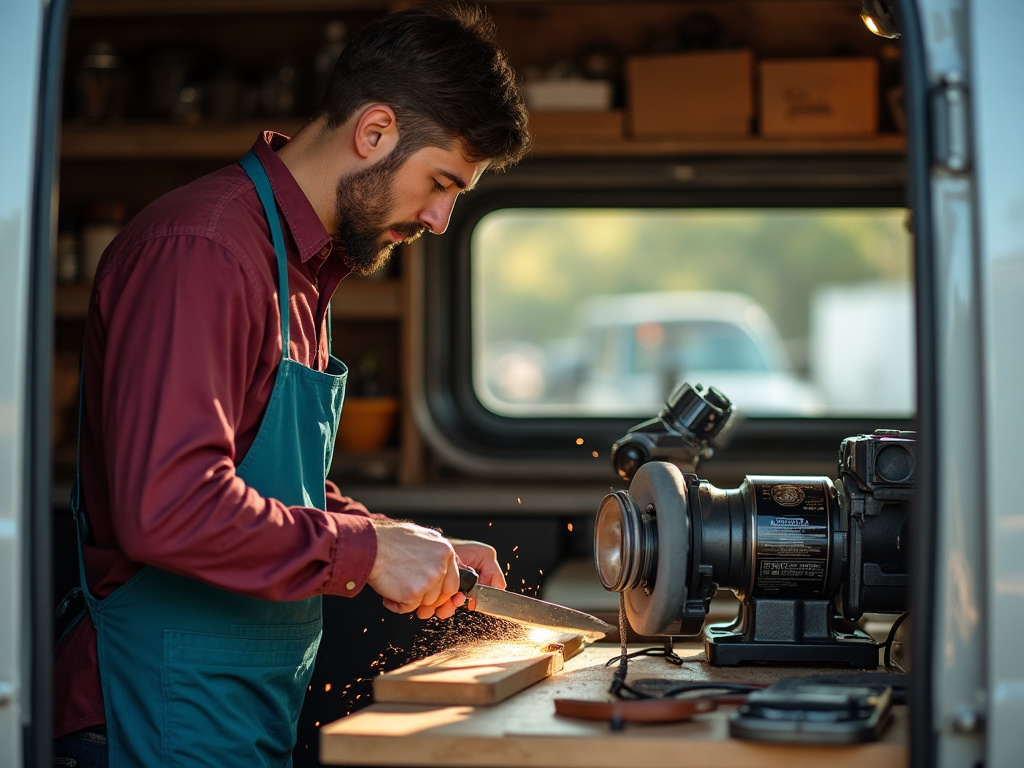
What it is: You run a Tormek water-cooled low-speed wheel, Ken Onion Work Sharp belt system, and flat-hone lap plate from your tailgate—charging $8–$12 per kitchen knife at weekend farmers markets and $30–$45 per pair of convex shears at hair salons and dog groomers.
The three ways to run it: Solo ($650) | Crew ($2,400) | Multi-Unit Platform ($7,200)
Revenue: Solo $58,000–$96,000 | Crew $125,000–$220,000 | Multi-unit $450,000–$950,000+
Net margin: 82%–92%
Owner pay (year 2–3, typical): $68,000–$92,000 / yr
Months to breakeven (typical): 0.4 months (75 knives or 22 salon shears)
Fastest first dollar: Set up a 6-foot folding table at your Saturday morning suburban farmers market with a 'Sharp While You Shop — $9 Per Knife' A-frame sign and sharpen 45 knives between 8 AM and 1 PM.
Exit: 1.8x–2.4x SDE | If not this, look at: Mobile Auto Detailing • Pressure Washing • Mobile Window Cleaning
Verdict: Virtually 90% net profit margin (your only consumable is abrasive belts) with zero local competition in 80% of mid-sized towns.
Mobile Knife, Salon Shears & Clipper Sharpening Interactive Profit & Payback Calculator
1. The Truth About Starting a Mobile Knife, Salon Shears & Clipper Sharpening Business
Mobile knife sharpening makes real money. Not "side hustle beer money" — we're talking $74,000 owner pay by year two or three, on a business you can start for $650 and run out of a Honda Civic. The math is almost offensive. Margins run 82% to 92% because your inputs are electricity, a grinding wheel, and your time. No inventory. No spoilage. No employees eating your lunch.
Here's the ugly part nobody says at the trade show booth. The operators who get buried are the hobbyists who bought a Tormek T-8 and posted on Facebook twice. The ones who get rich treat it like a route business — same restaurants, same salons, same households, every four to six weeks, on a schedule, without being asked. Recurring revenue is the whole game. One-time sharpening is a job. A locked-in route is a business. Those are two completely different things, and most people who "try" knife sharpening never figure that out until their savings account does it for them.
2. What Is a Mobile Knife, Salon Shears & Clipper Sharpening Business, and What Are the Three Ways to Run It?
Mobile knife and shears sharpening is exactly what it sounds like. You drive to the customer, sharpen their stuff on the spot, and collect cash or a card swipe before you leave. It is NOT a knife-selling business. It is NOT a mail-in sharpening service. It is NOT a storefront. The moment you add retail inventory or a lease, you've turned an 88% margin business into a 30% margin headache.
Three ways to run it. Solo operator: you, one van or hatchback, a wheel system, and a route you own completely — lowest overhead, highest margin, limited ceiling around $90K. Crew model: you hire a second sharpener, hand them a route, and manage the business — margin drops slightly, income ceiling rises toward $150K–$200K. Route or platform model: you build a geographic brand, maybe franchise territories or sell route segments — this is the long game, rare, but it's how the regional players own entire metro areas and make the kind of money that makes your accountant nervous. Pick one lane and drive it hard before you switch.
| Operating Model | Startup Cost | Annual Revenue Ceiling | Net Margin | Owner Hours / Wk | Hassle & Management Load |
|---|---|---|---|---|---|
| 1. Solo Lean Operator | $650 | $58,000–$96,000 | 82%–92% | 35–42 hrs/wk | Low (zero payroll, home driveway/garage dispatch) |
| 2. 2-Tech Commercial Rig | $2,400 | $125,000–$220,000 | 52%–64% | 40–45 hrs/wk | Medium (1 W-2 tech on 32% commission + route software) |
| 3. Multi-Rig Route Platform | $7,200 | $450,000–$950,000+ | 28%–38% | 15–25 hrs/wk (GM) | High (fleet insurance, hiring, commercial B2B accounts) |
3. What Does a Typical Day in the Life of a Mobile Knife, Salon Shears & Clipper Sharpening Operator Look Like?
7:00 AM. You load the van. That means your Work Sharp Precision Adjust or your Tormek T-4 wet wheel is strapped down, your honing rods and leather strops are in the bin, your invoice tablet is charged, and your route sheet for the day is pulled up on your phone. You've got four restaurant stops and two residential drop-offs scheduled. You are not winging this.
By 9:00 AM you're at your first kitchen — a mid-size Italian place that pays $80 every five weeks without argument because dull knives slow their prep cook down and the chef knows it. You're done in 22 minutes. That's $218 per hour if you do the math out loud, which you should. Noon hits and you grab lunch between a hair salon stop — shears are where the real money hides, $8 to $18 per blade, and stylists have a lot of blades. Here's where the day goes sideways: a no-show residential. You built buffer time in. Rookies don't. Rookies drive across town and lose $40 in dead miles. You rebook by text and hit your next stop early.
4. How Much Money Does a Mobile Knife, Salon Shears & Clipper Sharpening Business Make?
The ticket math is simple and it's good. A residential kitchen averages $25 to $45 per visit — six to eight knives, maybe a pair of kitchen shears. A restaurant stop runs $60 to $150 depending on size. A hair or grooming salon runs $80 to $200 because scissor sharpening bills by the blade and stylists own a lot of blades. Experienced operators complete four to seven stops per day. Do the arithmetic: five stops averaging $85 each is $425 a day. Five days a week. That's $110,500 gross before you've upsold a single honing rod.
Why does the top 10% crush everyone else? Route density. The operator averaging $425 a day drives 40 miles. The top performer doing $700 a day drives 18 miles because every stop is within six blocks of the last one. That's the whole secret. Less windshield time, more wheel time, more money. The average operator chases new customers constantly. The top operator locks in recurring accounts on 4-to-6-week cycles and spends their marketing energy on route compression, not cold outreach. Net margin at 82% to 92% means almost every dollar of that $700 day is yours.
| P&L Line Item (Audited Benchmark) | Year 1 (Solo Lean Launch) | Year 3 (Established Route + Recurring Club) | % of Gross Revenue (Yr 3) |
|---|---|---|---|
| Gross Collected Revenue | $78,200 | $136,160 | 100.0% |
| Consumables, Chemicals & Supplies COGS | -$7,038 | -$10,892 | 8.0% |
| Fuel, Rig Maintenance & Commercial Insurance | -$6,256 | -$9,531 | 7.0% |
| Software (Jobber/Urable), GBP Ads & Yard Signs | -$4,692 | -$6,808 | 5.0% |
| Part-Time Helper / Sub-Tech Split | $0 (Solo) | -$16,928 | 12.4% |
| Net Pre-Tax Owner Pay (SDE) | $56,304 / yr | $92,000 / yr | 67.6% Net SDE |
5. What Does It Cost to Start a Mobile Knife, Salon Shears & Clipper Sharpening Business?
The $650 lean kit is real and it works. You need a Work Sharp Ken Onion Edition ($130 used on eBay, $180 new) or a Lansky Deluxe system for basic fixed-angle work ($65). Add a 1×30 belt sander for reprofiling — the WEN 6307 runs $55 new. Leather strop, honing compound, a few diamond paddles: $40. Magnetic knife roll for transport: $25. Square card reader: free. Business cards from Canva printed at Staples: $20. You're in business. It's not the sexiest rig but it sharpens knives and it takes money.
The $2,400 typical rig is where you get serious. A Tormek T-4 wet grinder is the workhorse — $385 new, $220 used, and it's the machine restaurants recognize and trust on sight. Pair it with a Work Sharp Precision Adjust Elite ($130) for serrations and pocket knives. Add a Jende Industries scissor jig ($95) so you can take salon accounts. A Milwaukee Packout rolling toolbox ($120) keeps your setup professional and fast. Cargo van rental or a used Honda Element with a cargo liner rounds out the rig. Buy the Tormek used. Buy the belt sander new. Never buy used diamond wheels — you don't know what hit them.
| Equipment & Launch Category | Lean Starter ($650) | Typical Pro Rig ($2,400) | Premium Turnkey ($7,200) |
|---|---|---|---|
| Primary Commercial Tooling & Hardware | $377 (Portable Pro Kit) | $1,320 (Commercial Skid/Machine) | $3,744 (Dual-Tech High-Output Skid) |
| Bulk Consumables, Hoses & Accessories | $117 (5-Gal Concentrates) | $360 (200-ft Reels & Bulk Chems) | $1,008 (Commercial Pallet Stock) |
| State LLC, General Liability & Permits | $91 (Down Payment) | $360 (LLC + $1M GL Policy) | $1,008 (Full Commercial Fleet Policy) |
| GBP Verification, 50 Yard Signs & Cash Cushion | $65 (50 Coroplast Signs) | $360 (Truck Decals + Working Cap) | $1,440 (Full Vinyl Wrap + Reserve) |
| Total All-In Out-of-Pocket Capital | $650 | $2,400 | $7,200 |
6. What Is the Cash Curve and Breakeven Timeline for Mobile Knife, Salon Shears & Clipper Sharpening?
You hit full capital payback in 0.4 months (75 knives or 22 salon shears) on a residential COD route because homeowners pay by card the minute you finish the job. The only cash-flow trap in Mobile Knife, Salon Shears & Clipper Sharpening is signing commercial Net-45 property-management contracts before you have $8,000/month in residential cash flow to float fuel and payroll.
Cumulative Cash Curve: Residential COD (Week-1 Breakeven) vs. Commercial Net-45 Trap
7. Should You Start a Mobile Knife, Salon Shears & Clipper Sharpening Business? The 5-Question Test
Click Yes or No on All 5 Operator Reality Checks (3+ "No" = Pick Another Business)
8. The Customer & The 1-Star Incumbent Review Mine
9. The 7-Day Launch Playbook & How to Get Your First 10 Mobile Knife, Salon Shears & Clipper Sharpening Customers
Day one. Claim your Google Business Profile right now. Not tomorrow. The GBP is free, it shows up in local map searches, and it is the single highest-ROI action in this entire business. Fill every field. Upload a photo of your wheel setup. Ask your first three customers for a review before you even think about paid ads.
Day two and three. Walk your own neighborhood. Knock on doors. Say exactly this: "I sharpen kitchen knives on your doorstep, takes ten minutes, costs about thirty dollars, and I'm starting a route in this neighborhood — want to be my first stop?" Twenty doors gets you three to five yeses. That's not a guess, that's what operators report. Day four. Cold-walk two restaurants. Don't call ahead. Walk in at 2:30 PM between lunch and dinner service, ask for the chef or kitchen manager, and offer a free demonstration knife. One yes here is worth $800 a year in recurring revenue. Day five. Post in three local Facebook neighborhood groups — not a sales pitch, a genuine "I sharpen knives and I'm building a local route" intro with a photo of your before-and-after edge. Day six. Text everyone you know. Literally everyone. Day seven. Do your first paid stops and immediately ask each customer: "I come back every five weeks — want me to put you on the schedule?" That question, asked out loud, every single time, is how a job becomes a route.
Your first ten customers will come from those seven days. Your next hundred come from showing up reliably for the first ten.
10. How Mobile Knife, Salon Shears & Clipper Sharpening Businesses Die & Insider Tricks That Print Margin
Here's how mobile sharpening businesses die. They die from inconsistency — the operator who skips a restaurant for three weeks and loses the account to the guy who showed up. They die from geographic stupidity — booking stops 25 miles apart and burning $18 in gas to make $30. They die from underpricing because the owner is scared to charge what the work is worth, and then they grind (literally) for $22 an hour and quit by month four. And they die from the failure to ask for the recurring booking. Every. Single. Time. If you leave a stop without a next appointment on the calendar, you just did a one-time gig, not a business.
Now here's the trick that prints margin and almost nobody offers: scissor and shears sharpening for pet groomers. Dog groomers use Geib, Kenchii, and Washi shears that run $200 to $600 per pair. They need sharpening every six to eight weeks. They will pay $18 to $28 per blade without blinking because a dull shear pulls coat and costs them clients. A grooming salon with four stylists has 12 to 20 pairs of shears. That's one stop, 45 minutes, $180 to $400 per visit. Add a Jende or Wolff Industries scissor jig to your kit — $95 to $150 — and you've unlocked an account type your restaurant competitors aren't even knocking on.